| Prep Time: 5 mins | Total Time: 5 mins |
| Serves: ¾ cups |
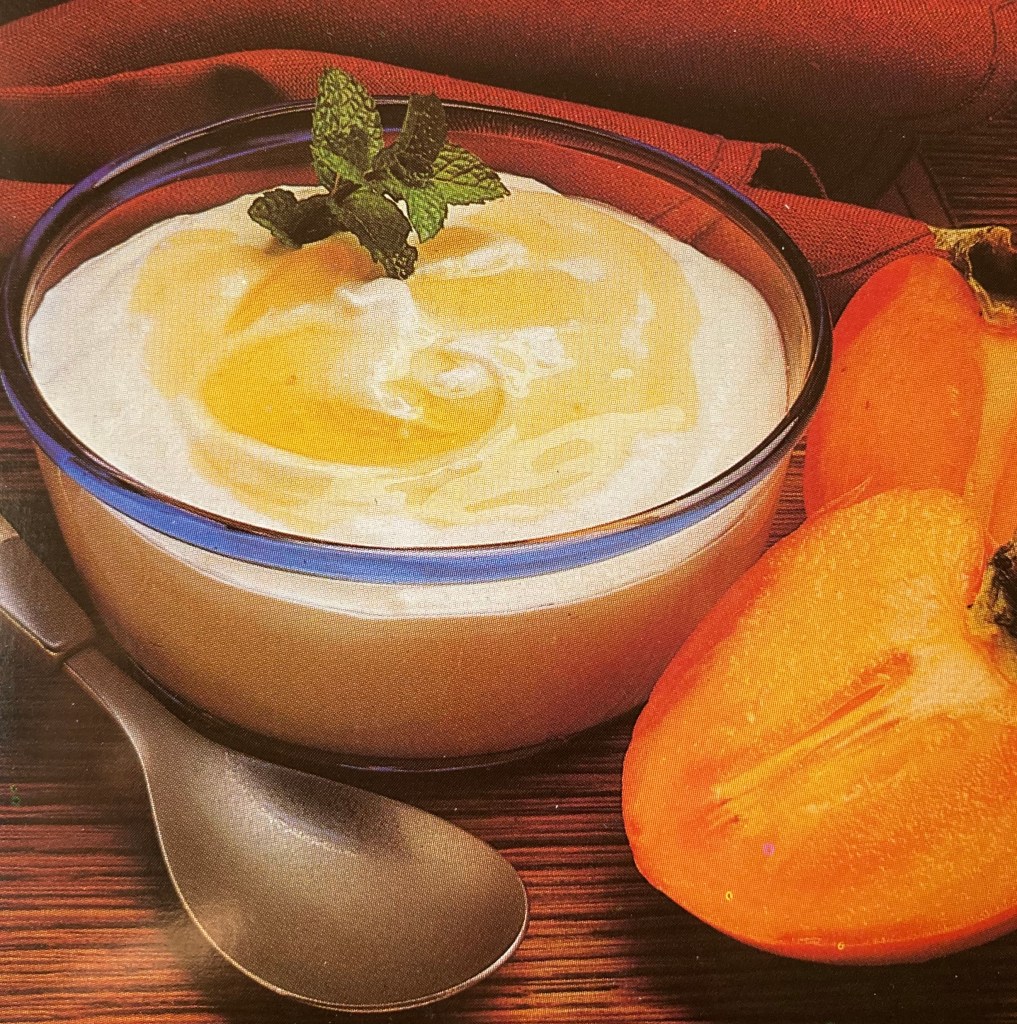
The semi-transparent, orangy-red pulp of the persimmon is deliciously sweet. If you blend it with a small amount of sour cream, honey, and citrus juice, it creates a creamy, apricot colored dressing that will become everyone’s favorite fruit salad topping.
From: My Great Recipes, 1981
INGREDIENTS
| ¼ | c | sour cream |
| 6 | T | orange juice |
| 2 | t | lemon juice |
| 2 | t | honey |
| pulp of 2 persimmons | ||
| mint sprigs |
STEPS
- Blend together all ingredients until well combined.
- Place in serving bowl. Garnish with mint sprig.
- Cover and refrigerate if not used. Dressing can be stored up to 1 week.
TIPS
- Some varieties of the Oriental persimmon have a large seed in the pulp that should be removed before blending. Persimmons have to be ripe to be eaten and should be very soft when ripe.
- Once you have tried this dressing, you might want to eat a persimmon “out-of-hand”. Cut in half, squeeze with a little lemon or lime juice and enjoy this delicious, low-calorie dessert which is rich in vitamins A and C and natural sugars.
- Also try persimmon spooned over vanilla or plain yogurt. Serve in long stemmed dessert glasses with a glass of fruit wine.
- Good served with grapefruit and avocado sections arranged on salad greens, or a cantaloupe half filled with fresh fruit and drizzle with the dressing.
What are Persimmons?
You may have noticed these delightfully orange fruits show up in the market in late October and early November. Beautiful, orange orbs with a point on the end, almost like a nut, compete with the plethora of apple varieties for the “most colorful fruit award” just before Thanksgiving.
Most of the persimmons in the United States are grown (of course) in California, where farmers produce about 10,000 tons of fruit yearly. They have gotten vastly more popular in recent years, going from a niche fruit which few knew about to a late fall staple at Trader Joes and Costco.
Persimmons (Diospryos kaki) are related to the black sapote, date plums, and the mabolo. The persimmons commonly available in the United States are called Oriental persimmons, (also Japanese persimmons or kaki), and are originally from China and later, Japan. The Eastern United States actually has a native persimmon, Diospyros virginiana, but its fruit is smaller and it is not as commercially viable.
Oriental persimmons have two types of subspecies: astringent and non-astringent. Astringent persimmons are only edible when extremely ripe and soft, before which they are firm. Non-astringent persimmons are edible hard or soft, ripe or unripe. Astringents are generally more sweet than non-astringent varieties.
You may have tried persimmons before, and found them too sweet, but I encourage you to find a different varietal. Just like apples, some types are sweeter than others. And because of the high genetic mobility of persimmons, even fruits of the same tree can taste drastically different.
Non-astringent persimmons are more popular in the US commercial market, both because they are shipped more easily without the danger of bruising and because Americans are more familiar with their texture. The most common varietal is the Fuyu, characterized by its round, squat body.
However, astringent varietals, such as the Israeli Sharon varietal, have a strong place in the commercial market, thanks to scientific innovation. In the 1970s, an artificial ripening technology was developed in Israel. Hard, unripened fruit was exposed to air enriched with CO2. This removed the tannins (the same molecule that lends the woodiness to red wine), and made them just as sweet, and just as transportable, because they remain hard. Today, while 80% of the treated Sharon persimmons remain inside Israel, Costco and H-Mart buy much of the rest.
If you compare Fuyu and Sharon fruit, the brix (how much sugar is in the fruit, again a term from winemaking) is around 12 in the Fuyu, and 23 in the Sharon. The Sharon fruits have almost double the sugar of the non-astringent variety.
The persimmons recommended in this recipe were likely the new astringent types, and the recipe aims to balance the almost too-sweet flavor with the tang of the sour cream.
 Trilo Bytes